How to dog-proof your Christmas tree
A stable stand, an inaccessible water reservoir and a..
Read more
No kennels close by? Try to find a kennel near your point of departure
Find a Kennel

A dog advent calendar is a lovely way to include your four-legged friend in the Christmas countdown. But the best one is not necessarily the biggest, prettiest or most expensive. It is the one your dog can enjoy comfortably, with treats that suit their age, diet and appetite.
A spectacular box is less useful if half the ingredients are unsuitable, the biscuits are too hard, or December's extra snacks push up their calorie intake. It is worth taking a moment to check what is actually behind the doors before you buy.
Our shortlist of dog advent calendars identifies simple meaty options, biscuit calendars, fish-based treats and larger mixed selections. If you need control over the contents, have a particularly fussy pooch, or want a more sustainable option, then a refillable calendar is worth considering.
Below, we look at the options, what you get for your money and the things to check before choosing an advent calendar for your dog.
|
Your priority |
Calendar to consider |
Why it makes the shortlist |
|
Lowest price |
A lower-cost mixed meaty selection. |
|
|
Biscuit calendar |
A small daily biscuit rather than a large chew. |
|
|
Simple meaty rewards |
A familiar brand and meaty treats behind the doors. |
|
|
Fish treats |
An alternative for dogs that already enjoy fish. |
|
|
A bigger selection |
A larger-format calendar for dogs that enjoy chewier treats. |
|
|
Mixed festive flavours |
Soft-baked festive treats with a range of ingredients. |
|
|
Large-breed treat variety |
A substantial selection of air-dried treats; check treat size carefully. |
|
|
A treat and a toy |
A simple countdown with chewy treats; check the exact edition. |
These are starting points, rather than assurances of suitability. In particular, “natural”, “grain free” and “hypoallergenic” do not tell you whether a product is appropriate for an individual allergy or a prescribed diet. If your dog has a particularly sensitive stomach we would always advise to use a fill your own advent calendar which you can fill with their normal and easily tolerated treat.
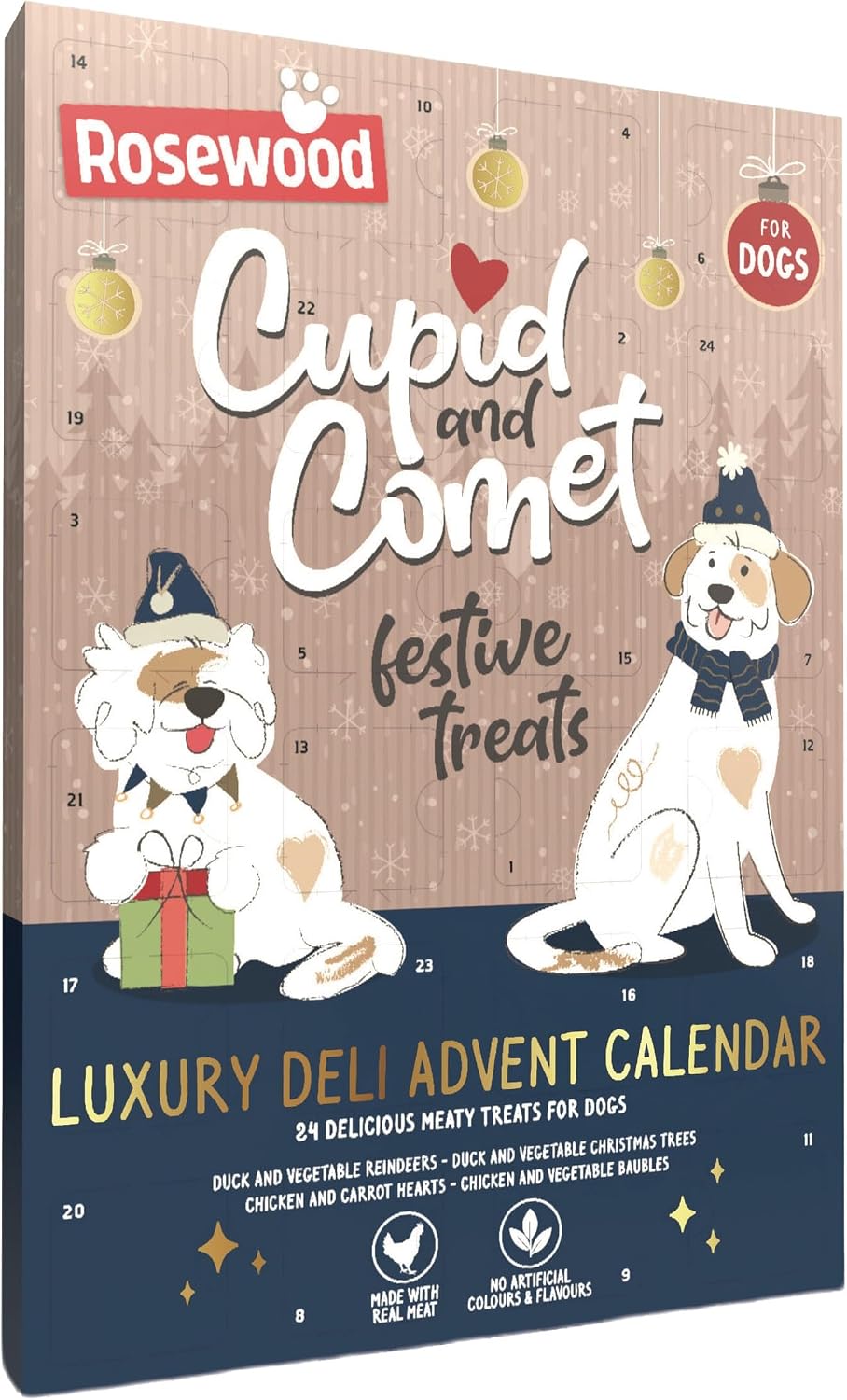
1. Rosewood Cupid & Comet Deli Dog Advent Calendar
Our pick for a budget-friendly mixed calendar
At around £6, Rosewood Cupid & Comet is one of the lower-priced options in this selection. The calendar is described as containing four kinds of meaty treats, including lamb and rosemary strips, duck and orange-glazed bites, turkey and stuffing-style meatballs, and chicken and carrot fingers.
The mix makes it a cheerful option if your dog already eats a variety of meat-based treats and you want something inexpensive for the countdown. It is not the best choice for a dog with a restricted protein diet, because several different animal ingredients appear across the selection.
Choose it if your dog is happy with a mixed meaty treat selection and you are looking for a modest festive extra. Check the current pack for the full ingredient list and feeding guidance before opening the first door.
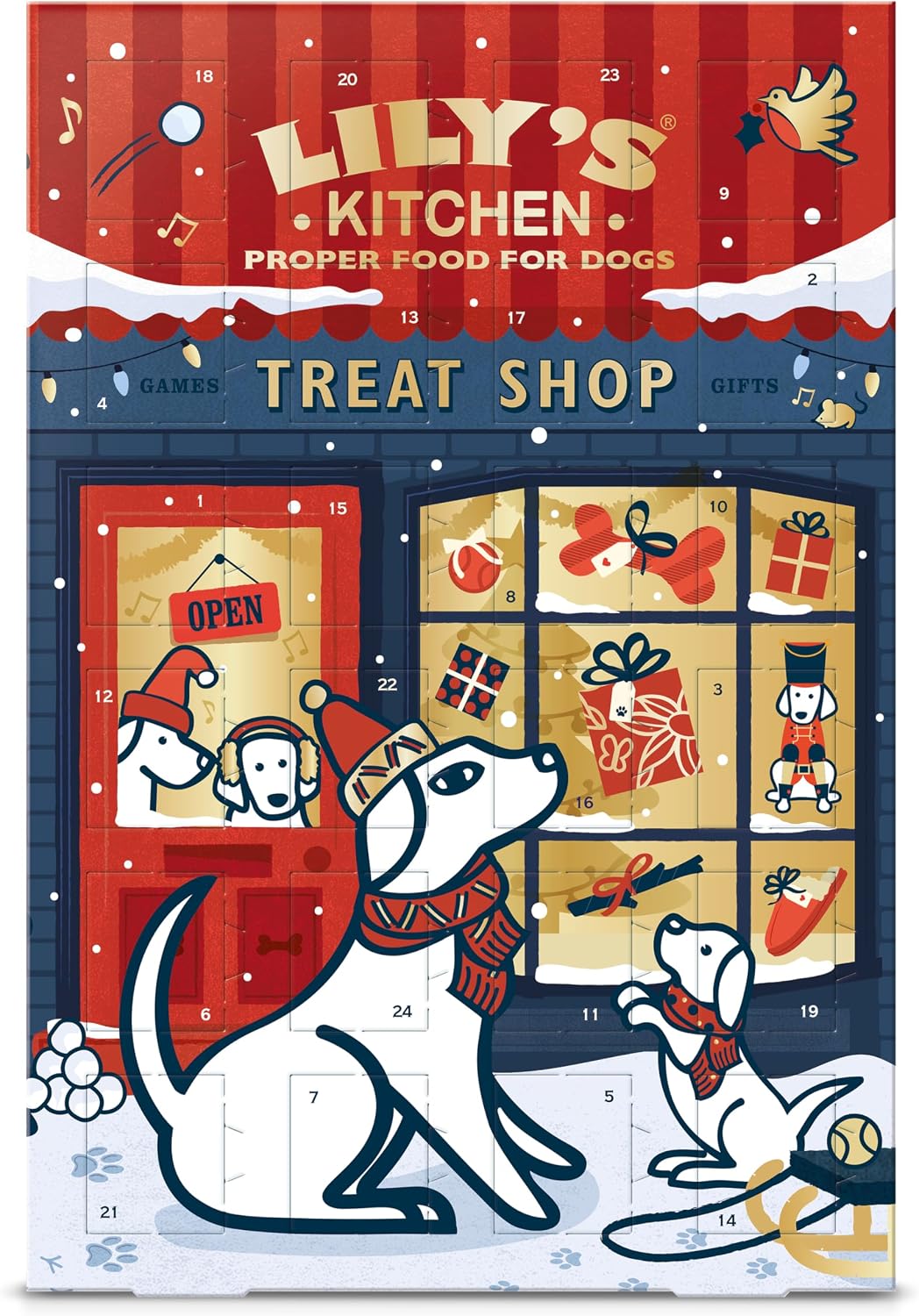
2. Lily's Kitchen Treat Shop Natural Ingredients Advent Calendar for Adult Dogs
Our pick for dogs that prefer biscuits
The Lily’s Kitchen calendar is around £10.50 and contains 24 small baked biscuits. The current selection includes Breaktime Biscuits with peanut butter and banana, alongside Bedtime Biscuits. The product information gives different energy values for the two recipes, so the calories are not identical from one day to the next.
At 68g in total, this is a relatively light calendar. That may be absolutely fine if you are buying for the presentation and a small daily ritual, but it is less compelling if your main objective is the largest quantity of treats for your money. The biscuits contain grains, and the recipes include peanut and dairy ingredients, so check these carefully.
Choose it if you want a biscuit calendar and your dog tolerates the listed ingredients. It is labelled for adult dogs; do not assume that a calendar intended for adult dogs is automatically suitable for a young puppy.
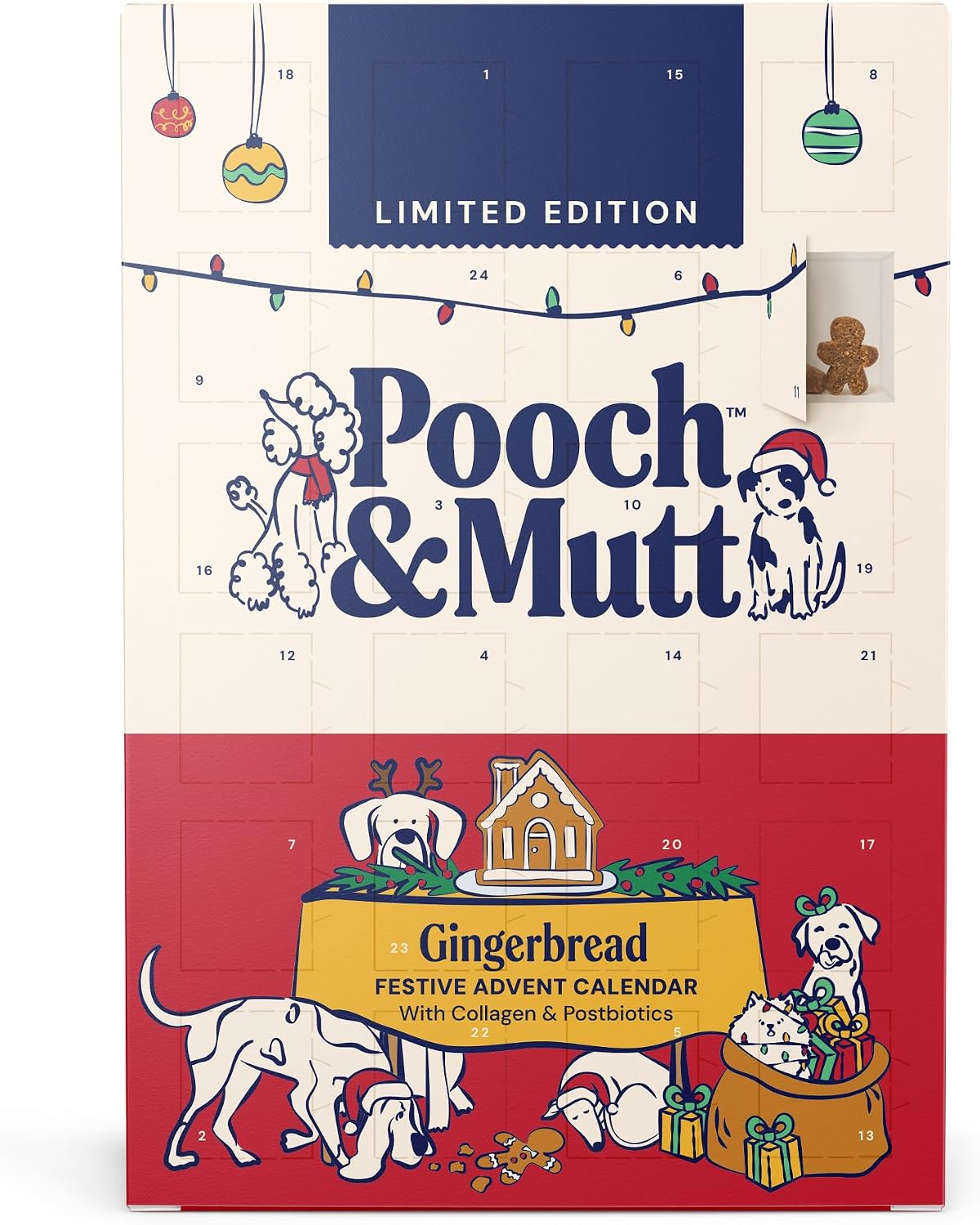
3. Pooch & Mutt Dog Advent Calendar
Our pick for meaty rewards
Pooch & Mutt’s dog advent calendar is a familiar option for owners who prefer meaty treats rather than biscuits. Contents change with different editions.
This is the sort of calendar that can fit naturally into a short training session, a calm greeting or the routine after a walk. Meaty treats can be useful rewards, but they still count towards your dog’s daily food allowance. Do not assume that two pieces behind a door are automatically the right portion for every dog.
Choose it if your dog already enjoys the ingredients in the current recipe. If you are buying to avoid poultry or another particular ingredient, read the complete ingredients for the exact edition rather than relying on the flavour name or an older review.
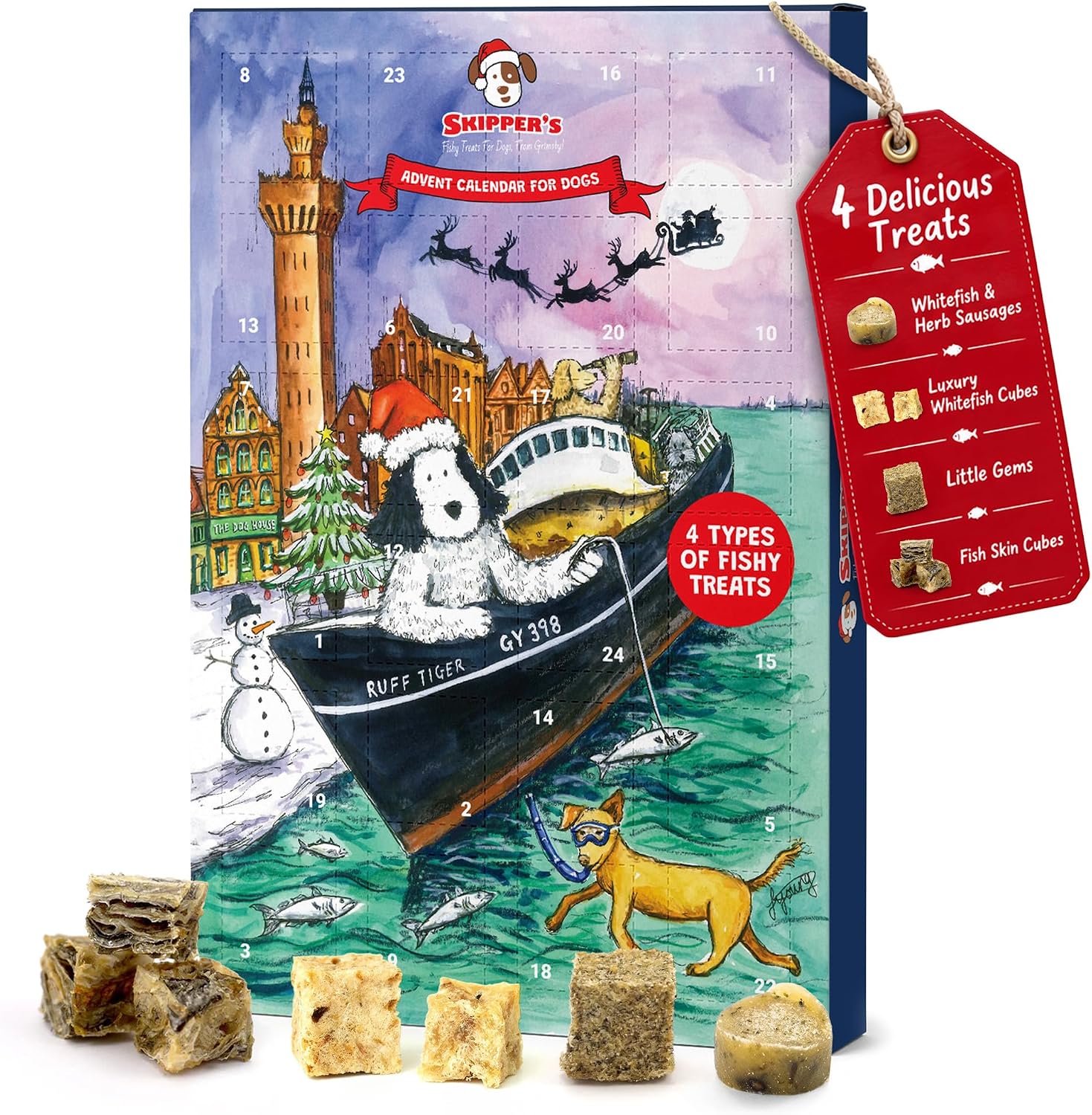
4. Skipper's Fishy Advent Calendar
Our pick for fish-loving dogs
Skipper’s fish-based calendar is a useful alternative to the poultry-heavy festive treats found in many dog calendars. The calendar contains a selection of fish treats behind 24 doors, including fish-skin and whitefish-style rewards.
This is worth considering if your dog already enjoys fish treats and you want a different flavour profile for December. It is not automatically suitable for every dog with a sensitive stomach or a food allergy. The species used, additional ingredients and possible cross-contact can all matter.
Some fish treats can be firm or contain bone fragments, so supervise your dog and consider whether the texture and size are appropriate.
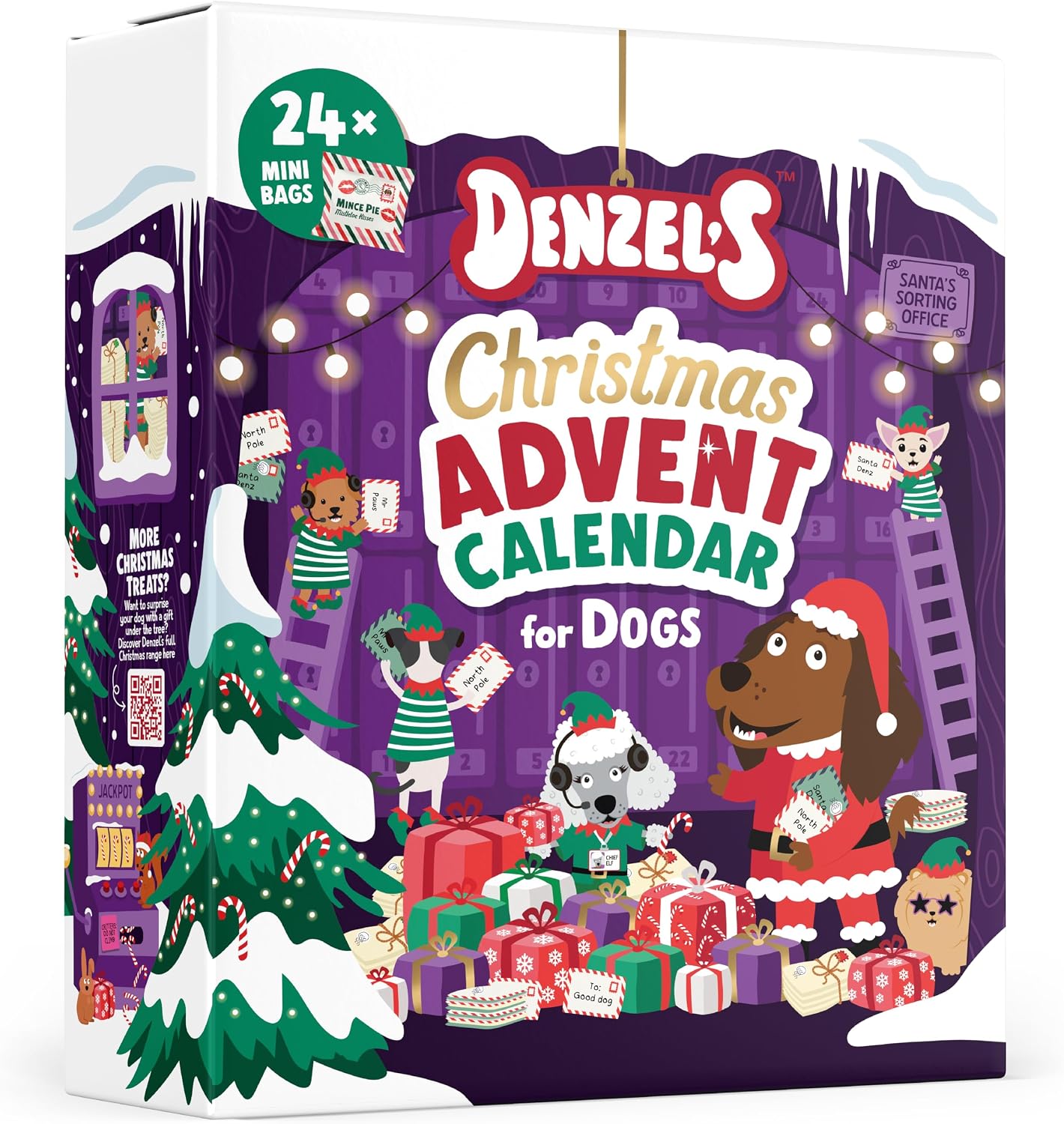
5. Denzel's Jumbo Christmas Dog Advent Calendar
Our pick for a larger treat selection
Denzel’s Jumbo calendar is a bigger-format option, with a selection of Christmas dog treats. It is a different proposition from a small biscuit calendar: the appeal is the more substantial treat selection rather than a tiny daily nibble.
That can make it a fun choice for dogs that enjoy chewier treats, but bigger does not automatically mean better value or a better fit. A large treat may need to be broken into suitable portions, and some dogs will find the contents too large or rich.
Choose it if your dog is comfortable with the size and style of treats included. Check the current ingredient list, treat dimensions and feeding guidance, particularly if you have a small dog, a puppy or a dog with a sensitive diet.
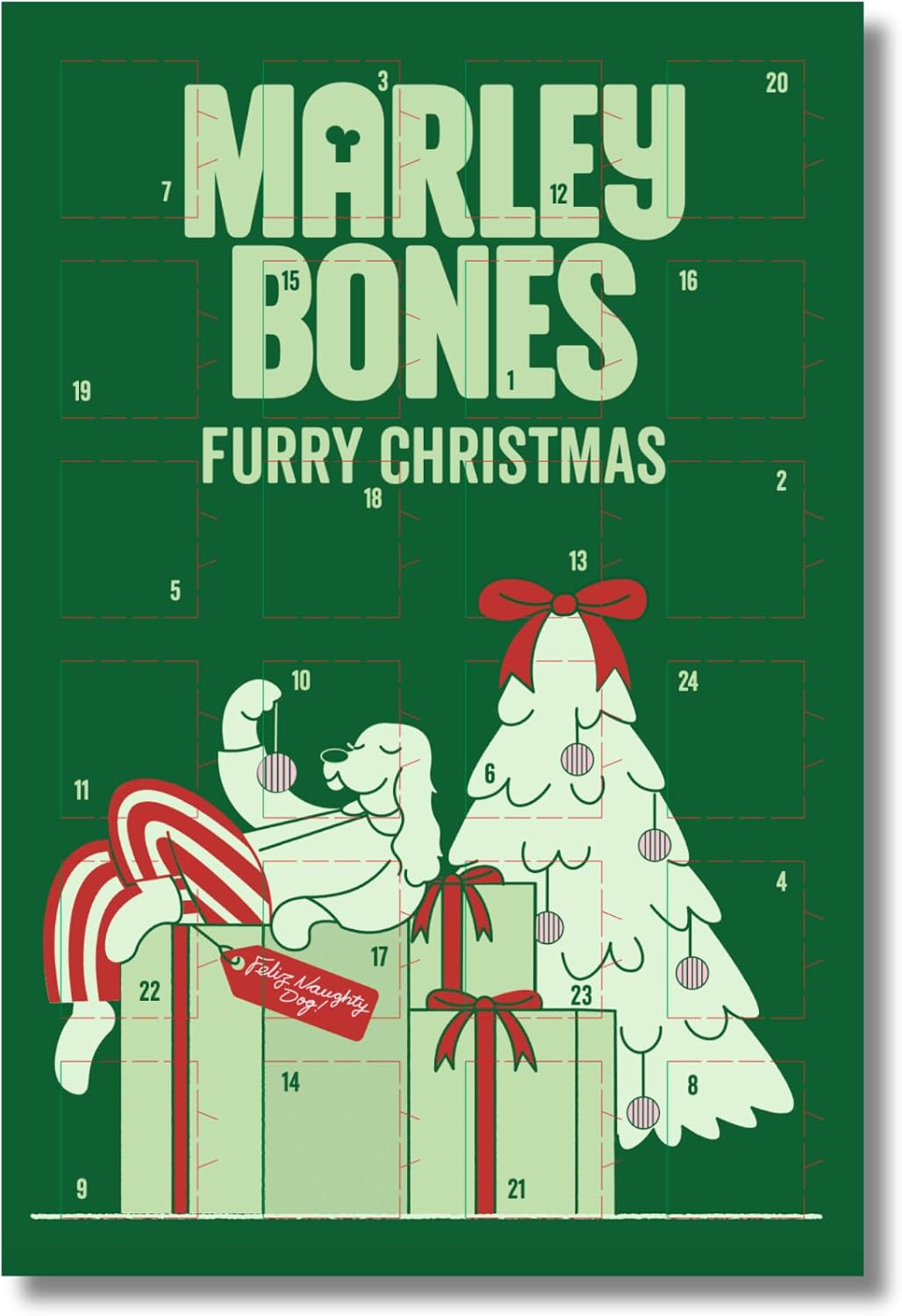
6. Marleybones Dog Advent Calendar
Our pick for soft-baked festive treats
Marleybones’ 2026 calendar is described as containing soft-baked festive dog treats, with ingredients such as turkey, beef, cranberry and chia seeds. It offers a different feel from a calendar filled with hard biscuits or larger air-dried chews.
The soft-baked format may appeal if your dog prefers a more tender treat, although you should always check the actual texture and size against your dog’s needs. The range of ingredients also means it is not a simple single-protein choice for dogs with dietary restrictions.
Choose it if your dog already tolerates the ingredients and you like the idea of a variety of soft-baked rewards. Check the current listing and pack, as seasonal recipes can change.
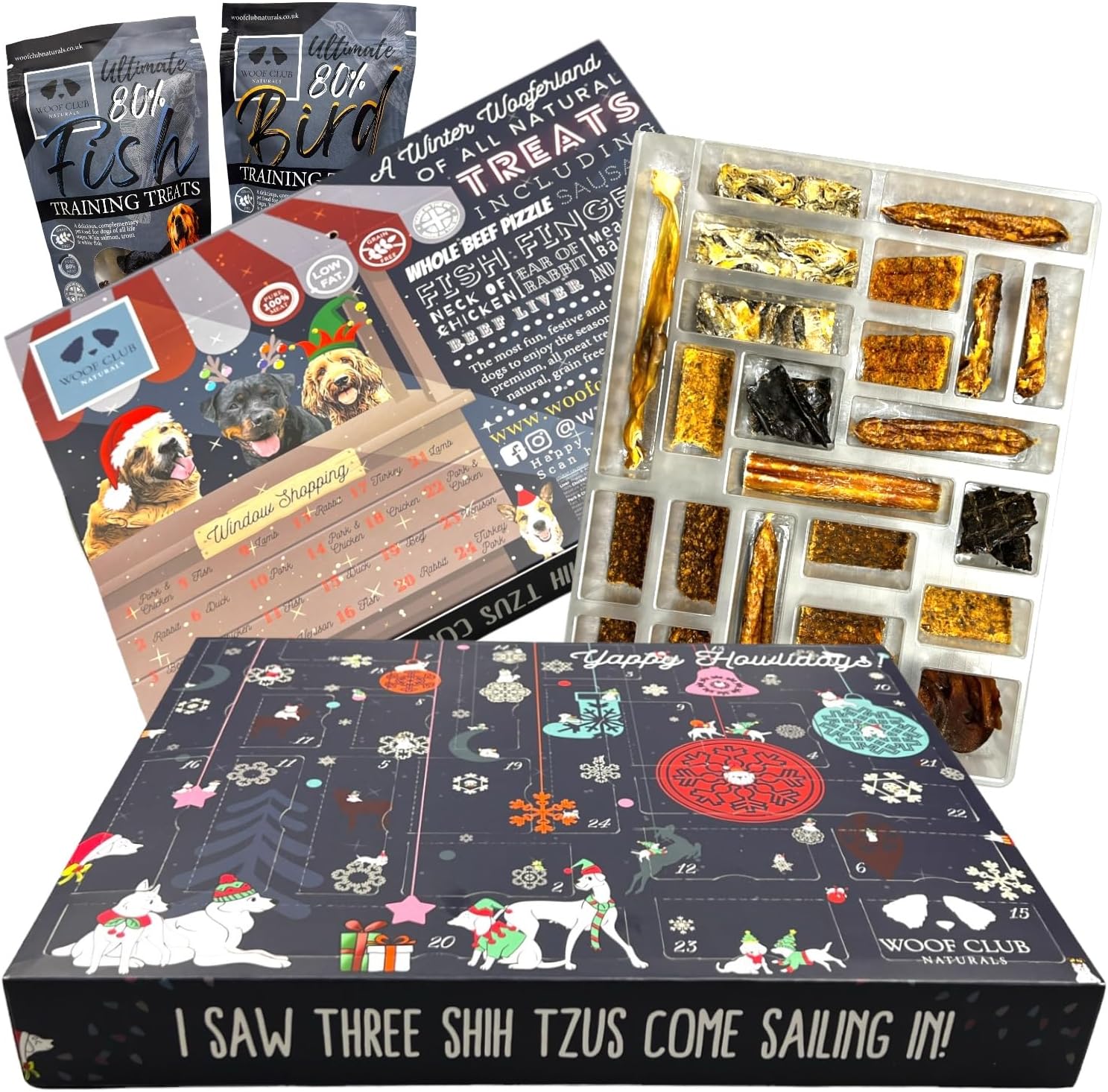
7. Woof Club Naturals Giant Advent Calendar
Our pick for large dogs and owners who want variety
Woof Club Naturals’ giant calendar is a more substantial option, with a selection of air-dried meat treats. The assortment described for the 2026 calendar includes a range of animal proteins and treat types, rather than one repeated biscuit.
The variety is the selling point, particularly for owners of larger dogs who may find small biscuit calendars underwhelming. It is also the reason to check the contents carefully: a selection that includes several proteins will not suit every dog, and individual treats may be large, chewy or rich.
Choose it if your dog is used to air-dried treats and can manage the size and texture. It is not a shortcut for dogs with allergies or prescribed diets. Check every ingredient and supervise chews, especially with enthusiastic or powerful chewers.
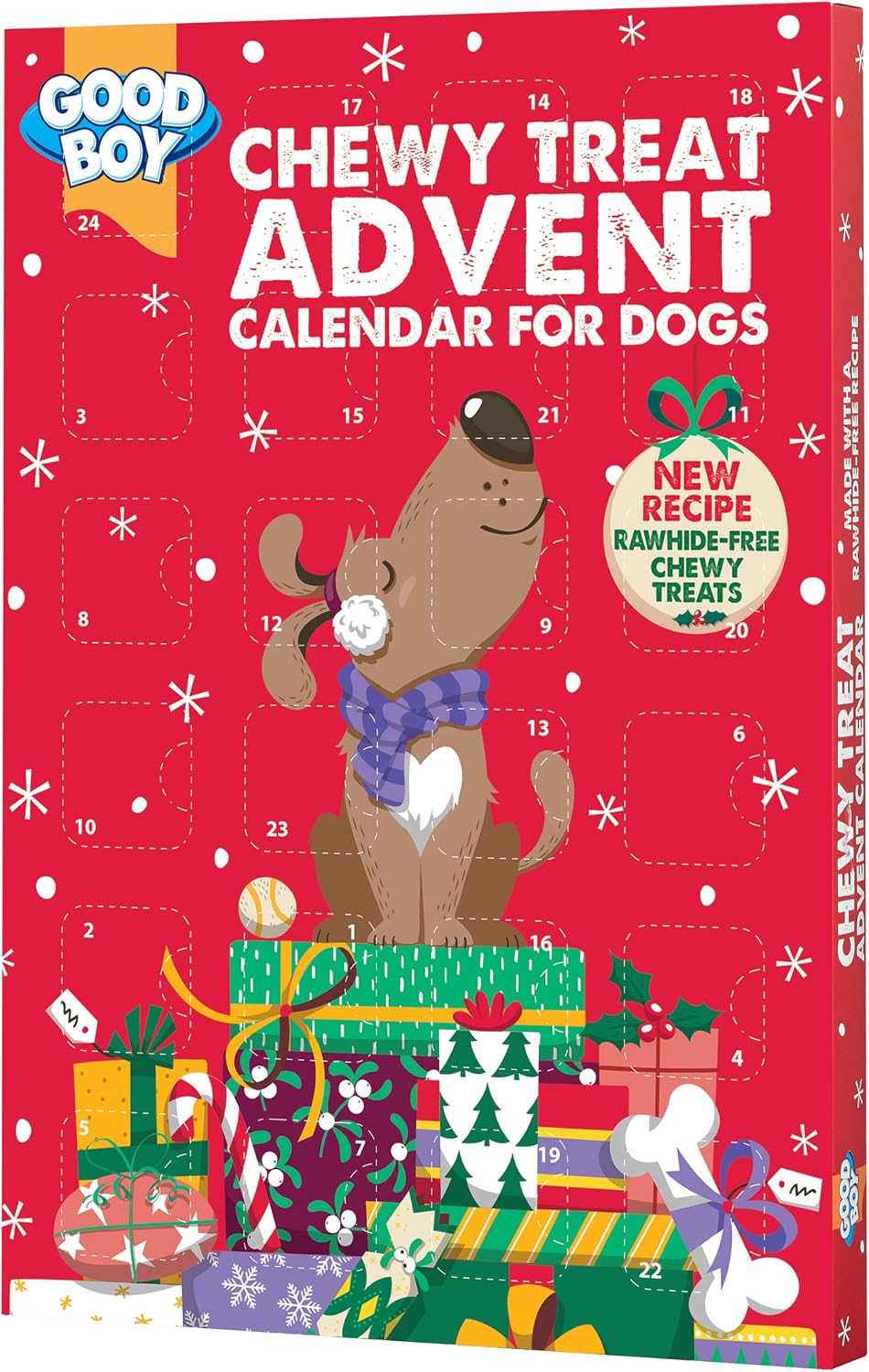
8. Good Boy Rawhide-Free Dog Advent Calendar
Our pick for a straightforward treat countdown
Good Boy’s rawhide-free calendar is a straightforward option built around chewy dog treats. A 24-day countdown, with chicken treats and guidance that it is not suitable for puppies under four months.
It is a simple choice if your dog already enjoys this style of chicken treat. As with any chewy reward, think about the size, texture and how your dog eats. Rawhide-free is a useful product description, but it does not mean the treats are suitable for every dog.
Choose it if the ingredients and chew style are appropriate for your dog. Check before you buy as Good Boy sells different Christmas calendars, including versions with a toy, and the contents are not interchangeable.
The lowest-risk shopping decision is usually the least surprising one. If your dog does well with a particular treat, start by checking whether its maker offers a calendar or whether you can use that treat in a refillable design. A Christmas box is an optional extra; it does not need to introduce six unfamiliar recipes which you don't know that your dog will like.
Read every recipe, including the large final-day treat. A turkey illustration on the front does not establish that the other windows are turkey-only. Look for additional meats, fish, milk derivatives, peanut butter, grains and other ingredients you already know you need to avoid.
For a gift, ask the owner what the dog can eat. That is more useful than guessing from the dog’s breed or buying whichever calendar looks the most luxurious. When you do not know the answer, a refillable calendar or a suitable non-food gift (such as a chew toy) leaves the owner more control.
There is no standard size for an advent treat. One window might contain a small biscuit, two meaty pieces, a bag of treats or a longer chew. Check what you will actually be feeding and whether you can divide it safely.
A large dog does not necessarily need a jumbo calendar: a small training reward can still be enjoyable. A small dog does not automatically need a calendar labelled “small breed”: the meaningful questions are the treat’s size, texture, energy and ingredients and whether your dog will like the treats inside.
If your dog tends to gulp, do not assume making every item tiny solves the problem. Appropriate shape and supervision matter as well. For a dog with dental pain or a swallowing problem, ask the veterinary team about suitable textures rather than choosing based on a product photograph.
First check suitability, then the delivered price, then the quantity. Price per 100g can help compare food quantity, but it cannot tell you whether your dog will enjoy the contents or whether you will use them all. A large box of unsuitable treats is poor value even at a low unit price.
Price per day is useful for comparing the cost of the festive ritual. It is not a feeding recommendation. Check whether a calendar has 24 or 25 treat days, whether there are multiple treats behind each door and whether the final compartment contains a larger bonus.
Calculate your puppy’s age on the day you intend to start feeding, not just on the day you order. A puppy arriving in November may be older by December, but that does not make every treat suitable.
Follow the minimum age and feeding instructions for the exact product you buy. These are product-specific instructions, not interchangeable rules for puppies as a group. If the packet and website disagree, contact the seller or manufacturer and wait for a clear answer.
Introduce any new treat cautiously, keep servings small and supervise. Very young puppies do not need a daily commercial festive treat to participate: a little attention or some of their permitted usual food can form a similar ritual that they will love equally as much.
There is no calendar we can responsibly recommend as suitable for every dog with a food allergy. Your dog’s trigger matters more than a general claim on the box. A short ingredient list can help with checking, but it does not guarantee freedom from a particular allergen or manufacturing cross-contact.
This is especially important during a diagnostic food trial. Follow the prescribed diet and do not add ordinary dog treats or dental sticks unless the veterinary team has agreed an alternative. A calendar marketed as natural, grain free or hypoallergenic does not override those instructions.
If your vet allows some of the prescribed food to be used as rewards, a refillable calendar may let you keep the festive routine without introducing another food. Keep portions within the existing daily allocation. Where even that is impractical, choose a non-food countdown based on play or extra special attention.
For this purchase, grain-free is an ingredient filter. It is useful when you have a specific reason to avoid the grains in another recipe. It does not tell you the calories, fat level, treat size or suitability for a meat, dairy or peanut allergy.
A dog that tolerates oats or rye does not need to avoid a biscuit calendar simply because a competing product says grain free. Choose around the complete recipe and your dog’s needs rather than treating one label as an overall health score.
The biggest feeding mistake is adding an advent serving on top of every reward your dog already receives. Include training treats, dental chews, leftovers and food used to give medication when you think about extras.
WSAVA advises that treats should contribute no more than 10% of a dog’s daily calorie intake and that treats should not replace a complete, balanced diet. Your veterinary team can help establish the appropriate daily intake and any tighter limits for your dog.
Reaching the 10% ceiling is not a goal. A dog may need less, and the allowance has to cover all other extras that day. If your current rewards already use the allowance, a portion of the normal diet or a non-food activity may be more practical.
To work out a weighed serving, multiply its weight in grams by the listed kcal per 100g, then divide by 100. For example, 2g of a treat listed at 310 kcal per 100g contains 6.2 kcal. You still need to know whether that ingredient and texture suit your dog.
If a brand gives only a fat percentage, do not convert that into a made-up calorie count. Ask the manufacturer for metabolizable energy information. If you are unsure how to adjust meals while keeping the diet balanced, ask your vet or vet nurse.
Human chocolate and a dog-specific carob treat are different products. Chocolate can poison dogs; raisins, currants and sultanas in Christmas baking are also dangerous. Xylitol is another ingredient to keep away from dogs altogether. Veterinary and animal-welfare guidance is clear that human festive food needs careful control.
Carob calendars can avoid cocoa while still containing substantial fat, sugar or milk ingredients. Check the complete composition rather than assuming “dog chocolate” is a free pass. If you need to avoid dairy, a carob product deserves just as much scrutiny as a yoghurt biscuit.
Festive names are not recipes. A dog treat called “Mince Pie Kisses” is not an invitation to offer a piece of your own mince pie. A dog-specific peanut butter recipe does not establish that every jar of peanut butter in the cupboard is appropriate. Check human products for xylitol, and use foods approved for your dog.
Keep human and dog calendars in separate, inaccessible places. If a dog eats human chocolate, raisins, xylitol or another potentially toxic food, contact your vet immediately rather than waiting for symptoms. Keep the packaging so you can explain what was eaten, how much may be missing and when it happened.
Open the window yourself, take out the food and put the calendar away before feeding. Cardboard, foil, trays, plastic sachets and hanging accessories are packaging, not part of the reward. A dog that learns to raid the calendar can consume several days’ food and swallow packaging in the same incident.
Feed the reward somewhere calm and supervised. If your dog guards food or you have several dogs, give each their portion separately. Do not gather them around a single open box and expect them to negotiate who gets the treat.
Store the calendar exactly as the pack requires, away from heat and moisture. Retain recipe panels, batch details and best-before dates. Once you open an individual bag, follow its instructions rather than assuming the closed calendar’s shelf life still applies to that bag.
Christmas Day deserves the same portion control as 1 December. A whole packet behind the final door can be saved for later. You can also pause the countdown if your dog is unwell or the contents are unsuitable; there is no need to catch up by feeding several days at once.
A reusable dog advent calendar lets you choose both the food and the serving size. It can be especially convenient if you already have a treat your dog tolerates or want to reserve some of their usual dry food for the daily ritual. It is also helpful if your dog is particularly fussy or if they have lots of allergies.
Compare the holder, this year’s contents and future refills. Reusability alone does not guarantee a cash saving: include the price of the holder, food, delivery and any replacement parts when you compare it with buying a new calendar each year.
A homemade version can cost less again. Use a human-operated numbered system and keep the food separately in its original packaging, taking out the appropriate portion each day. That avoids storing loose food in a decorative pocket or exposing 24 portions to the room for weeks.
If you use a hanging holder, put it where your dog cannot reach it even when standing up or jumping. Do not attach food where the dog can pull off elastic or string. The useful part is the owner-controlled countdown, not encouraging a dog to dismantle the display.
For dogs that cannot have additional food, make the day’s event a short game, a sniffing activity or another form of attention they enjoy. You can still mark each date without buying 24 new toys. Where food restrictions are medical, confirm any food-based enrichment with the veterinary team.
Buy early enough to receive and inspect the calendar before 1 December. Seasonal products can sell out, and a listing being visible does not guarantee that it will arrive in time. Don't buy so early that food will be out of date, some sellers sell last year's calendar this year so make sure that food is in date before you order and when it arrives.
Before checkout, confirm four things: the exact edition, the ingredient panel, the total delivered price and the expected delivery date. Check that the best-before date will cover the period when you plan to use the contents, including any food you intend to save after Christmas.
Seasonal listings can change. A page with “2026” in its headline can still display an old photograph or an older recipe description. If the information conflicts, ask for a current pack photograph rather than assuming the newest date is the right one.
Delivery can reverse a small price difference. Compare the final basket you actually need, rather than spending substantially more on unrelated items just to reach free delivery.
For multi-dog households, work out each dog’s portion separately. One mixed calendar may be economical if you can divide appropriate treats, but it is a poor shortcut if the dogs need different diets. The treat that suits one dog should not become the other’s reward simply to keep the countdown symmetrical.
For a budget-friendly mixed option, consider Rosewood Cupid & Comet. Lily’s Kitchen is a biscuit-style choice, while Pooch & Mutt and Skipper’s offer meaty and fish-based alternatives. The best choice changes when you need a particular ingredient, texture or feeding plan; use the shortlist rather than treating it as a universal ranking.
A calendar can be suitable when the food, serving size and texture are appropriate for your dog and you follow the current pack guidance. Keep the packaging out of reach. Dog-specific branding does not establish that every recipe is suitable for every puppy, allergy or medical diet.
Only if the individual product’s minimum age and contents are suitable for that puppy. Check their age on the intended feeding date, introduce unfamiliar food carefully and supervise. Where age guidance conflicts, get a clear answer from the manufacturer or choose something more clearly labelled. A puppy can join in with permitted usual food instead.
Use the pack’s instructions and your dog’s existing feeding plan. A window containing two biscuits or a bag of treats is not necessarily a suitable one-sitting portion. Account for every other reward that day, and keep or share appropriate leftovers rather than automatically feeding the whole compartment.
Prioritise manageable pieces, a suitable texture and calories you can account for. The lightest box is not automatically best, because energy density varies. If necessary, choose a refillable design with measured portions of an already suitable food, and do not assume a large chew becomes appropriate simply by breaking it up.
“Natural” does not answer the questions that matter most: ingredients, energy, fat, texture and portion size. A natural meat treat may still be energy dense, and a biscuit can still be appropriate in a small amount. Choose using the full label and your dog’s needs rather than the front-of-pack adjective. Bear in mind that any treat can become a choke hazard and always supervise your dog when they consume any food.
Fish-based and plant-based options may be available, but check the current contents and any relevant cross-contact information before ordering. Do not rely on the main flavour or a picture on the box. For a diagnosed allergy, confirm the choice with the veterinary team managing the diet.
Carob products are marketed as alternatives to ordinary chocolate. They still need ingredient and portion checks, especially for milk ingredients and energy. Never use a human chocolate calendar for a dog, and keep the two types stored separately so other family members do not confuse them.
Yes, if the contents suit both dogs and each receives an appropriate portion. Feed them separately when needed and record the extras within each dog’s allowance. Do not assume two treats behind a window means one each will be right for dogs of very different sizes or with different dietary needs.
Use a food your dog can already eat, stored in a suitable way and measured into appropriate portions. Reserving some of the normal daily dry food can keep the ritual simple. For veterinary diets, ask the vet which rewards are permitted. The holder, elastic, string and decorations must remain out of reach.
They can be, if the food suits your dog and you compare the delivered cost. A budget calendar buys a different kind of reward from a larger meat assortment, so price alone does not decide value. Check the label carefully and spend more only when the contents, format or useful information justify it.
You can, provided the ingredients and preparation are appropriate for your dog and you follow suitable food storage guidance. A homemade treat still counts as food, and “sugar free” human ingredients need checking for sweeteners such as xylitol.
Start with the ingredients and portions you can use, then choose the presentation you like. For many dogs, a familiar reward in a modest calendar will be the most practical purchase. A refillable design offers more control when the prefilled options do not fit.
The calendar should add a small enjoyable routine to December. Keep meals balanced, supervise the reward and store the rest securely.
This guide is based on product and retailer information available when the research was carried out in November 2026. Product listings, prices, availability, recipes and pack sizes can change, particularly for seasonal products. Prices mentioned in this article are reference prices only, exclude delivery unless stated and are not a guarantee of stock or price at checkout.
The products included in this shortlist were identified through Amazon UK listings or Amazon-linked product roundups at the time of research. Links take you to Amazon UK search results for the named product so you can check the current edition, seller, price, delivery details and availability before buying. A search result does not guarantee that a product remains in stock or that Amazon itself is the seller.
These are research-based recommendations. We have not physically tested the calendars, fed the treats to dogs or independently measured their contents. Product descriptions, ingredients, ages and nutrition information are taken from published listings and manufacturer information where available. Always check the actual packaging before feeding, as recipes and guidance may change between editions.
Some links in this article may be affiliate links. If you buy through one of these links, we may earn a small commission at no extra cost to you. This does not affect the price you pay or the products we choose to include.
This article is for general information and is not veterinary advice. If your dog has a diagnosed allergy, a medical condition, is on a prescribed or elimination diet, or has difficulty chewing or swallowing, speak to your veterinary team before introducing treats.
Updated 10 November 2026